Pop quiz: What is Benghazi? A, a place, B, a revolution, or C, an attack? Any clue? Well regardless your answer, you’re probably right because trick question, it depends on when you’re being asked? Before Benghazi became synonymous with a terrorist attack on American citizens, it was a city experiencing turmoil in the state of Libya located on the edge of the African continent.
A year before the Benghazi attack occurred, Libya, along with other states in North Africa and the Middle East, were experiencing mass protest for government reform – collectively known as the Arab Spring. Starting in Tunisia, a country to the North West of Libya, unemployed twenty- six year old Mohamed Bouazizia set himself ablaze in front of a government building after being repeatedly harassed by local officials asking for bribes or threatening to confiscate his merchandise at his refusal since they knew he was selling without a permit. But Mohamed continued to sale regardless due to a need to support his widowed mother and six siblings. His final straw arrived though when a policewoman humiliated him publicly by slapping him. Captured on camera, Mohamed unknowing become a martyr. Within days, rallies popped up across the country against unemployment, poverty, and the government’s misuse of power, calling for Zine El Abidine Ben Ali, their president at the time, and his regime to step down. Wanting to remain in power and continue his twenty-four year reign, Ben Ali opposed the protesters by sending out troops to disperse the crowds, apparently with excessive violence according to international criticism from the United States. “I condemn and deplore the use of violence against citizens peacefully voicing their opinion in Tunisia, and I applaud the courage and dignity of the Tunisian people,” spoke Barack Obama. Attempting to comply with the protestors and gain favor over the situation, Ben Ali promised he would not serve another term after completing the remaining three years of his current term as well as reducing food prices and releasing some of the restrictions over the internet. But the protestors were not sated and the situation escalated, climaxing with a state of emergency being declared as Ben Ali fled the country leaving prime minister Mohamed Ghannouchi as interim president, and re-elections occurring in six months.
Although not smooth, the success of Tunisia’s rebellion inspired countries in its surrounding area to follow their lead and overthrow the dictators of their corresponding counties. Egypt, another example of a country participating in the Arab Spring, attempted rebellion with mixed results. While they were able to overthrow their President Hosni Mubarak, who had ruled for thirty years, the absence of an official power left the country in dishevel with protestors who had once agreed, now feuding. Left under the leadership of the military, things were far from well, but Egypt no longer had a dictator like leader and was considered a success.
If ranked on a scale from success to failure, Tunisia would be a success, Egypt would be in the middle, and Libya closer to failure.
On February 15, 201l, after the detainment of human rights lawyer Fethi Tarbel, anti-government rallies were held calling for the release of political prisoners and the denouement of Muammar al-Qaddafi from the position of president. In response to the anti-government demonstrations, Libyan officials conducted and televised a counter protest, pro-government, using violence to disperse the protestors. First using water hoses and rubber bullets, the violence intensified as the revolution spread to other cities like Tripoli where many ambassador and envoys were staying. Regressing from rubber bullets to mercenaries firing live ammunition into crowds and killing demonstrators by the masses, the regime only got worse, now restricting communication with the international community by blocking the internet and interfering with telecommunication.
Regardless of al-Qaddafi’s attempts to mask his violence towards his citizens, the international community responded in solidarity against his regime by flying Libya’s pre-Qaddafi flag. Discrepancy was also seen in al-Qaddafi’s own government as the minister of justice and a number of Libyan diplomats resigned in protest. Even members of the military were conflicted, as some members chose to defect instead of serve under al-Qaddafi commands.
But as the al-Qaddafi attempts to maintain his position in power progressively got more and more violent and nearer to international ambassadors, countries were forced to evacuate their ambassadors. Although, this did not completely inhibit international effort to detain al-Qaddafi. The UN Security Council agreed to place sanctions against al-Qaddafi, effectively placing a travel ban and embargo on weapons. Individual countries also placed their own sanctions such as the United States who announced they had at least frozen thirty billion of al-Qaddafi assets.
International effort to force al-Qaddafi to step down would only continue to increase as intergovernmental organizations debated the best way to break the stalemate between al-Qaddafis forces and the rebaling citizens. Was a diplomatic solution still achievable, or was military intervention required? IGOs such as African Union and the Arab Nations strictly wanted to avoid military intervention but on March 27 2011, NATO, North Atlantic Treaty Organization took command of military operations. Even so, it still took further intervention from more countries such as the United Kingdom, France, and Italy to aid rebel forces through military advisement without the advisor actually participating in the conflict. Eventually, months later in August 2011, the stalemate began to break as the Transitional National Council, a merger of local rebel groups, began to assume power and officially overthrew al-Qaddafi regime in September 2011.
It would be an entire year, until the Benghazi attack occurred on September 11, 2012 when United States Ambassador Christopher Stevens and three other Americans –information officer Sean Smith and Navy SEALs Glen Doherty and Tyrone Woods– would be killed.
To be discussed on the next episode of Overly Complicated, Who was Ambassador Christopher Stevens and why was he in Benghazi, Libya in the first place.
Appendix
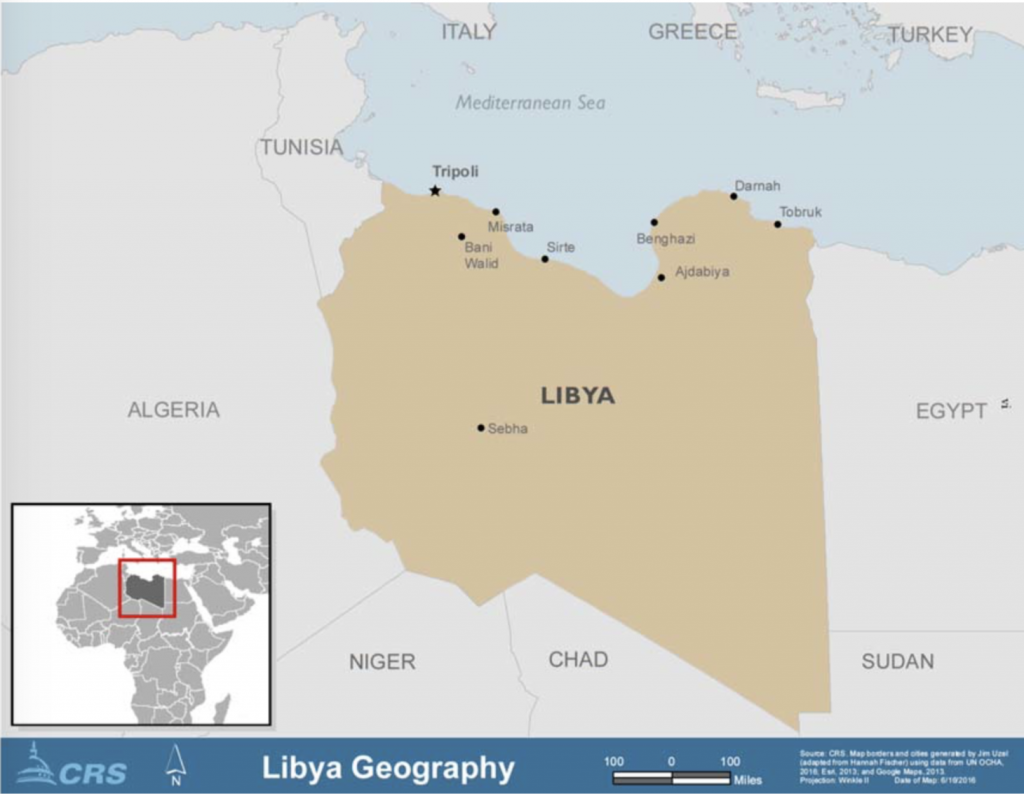
Above is a map depicting Tunisia, where the Arab Spring started and Libya where the Benghazi attack occurred. Benghazi is in the north east of Libya.
Bibliography
Clarke, John I., and Talbi, Mohamed “Tunisia.” Encyclopedia Britannica Online. Encyclopedia Britannica Inc., 2018. Web. 25 Nov. 2018.
Cunningham, John M., and Tesch, Noah “Libya Revolt of 2011.” Encyclopedia Britannica Online. Encyclopedia Britannica Inc., 2018. Web. 25 Nov. 2018.
Masad, Ilana. “What happened to the revolution in Egypt.” The Washington Post 3 Mar. 2017: n.a. Washington Post. 24 Nov. 2018
NPR Staff. “The Arab Spring: A Year Of Revolution.” NPR, NPR, 2011, https://www.npr.org/2011/12/17/143897126/the-arab-spring-a-year-of-revolution.
“It was difficult to get there at the time. There weren’t any flights. So we came in by a Greek cargo ship and unloaded our gear and our cars and set up our office there,” these are the words of former US Ambassador Christopher Stevens, “My mandate was to go out and meet as many members of the leadership as I could in the Transitional National Council.” Stevens is referencing his return to Libya after having evacuated two months prior in February of 2011 during the risings of the Libyan Revolution. And the leadership he’s speaking of meeting, the Transitional National Council, was the unofficial government of Libya as rebel citizens along with foreign aid attempted to denounce Muammar al-Qaddafi.
As outlined in the previous episode What? When? the Libyan revolution was a long term affair, starting early 2011 in February and dragging for almost the duration of a year before finally ending in September 2011. So, what was US Ambassador Christopher Stevens doing back in Libya after having previously fled due to dangerous conditions? Was he an adrenaline seeker who took trill in surviving dangerous situations?
Yes, and no. Yes, Stevens did purposely journey to turbulent countries and make it a point to observe disasters first hand, but not for the thrill of it. As an ambassador, Stevens felt it was important to experience the plights of a country in order to relate to the citizens he was seeking to help. Stevens believed in open communication and loved to talk to the people regardless of the boundaries. According to Robin Wright, a former foreign correspondent and friend to Stevens, “He knew the streets, not just the elites. He had an infectious enthusiasm about the extraordinary history playing out across the Middle East, which he witnessed up close. He got it. He spoke the language and knew the culture. He never flinched even slightly about the dangers — whether serving in a country when Qaddafi was in power, or heading the U.S. office in Benghazi during Libya’s uprising, or going back to become ambassador during a difficult transition.” Stevens loved the country of Libya and was “thrilled to watch the Libyan people stand up and demand their rights,” as he expressed himself in a state department video before assuming his post in Libya as its United States ambassador.
So, we know why Stevens was in Libya, he loved and wanted to help the people achieve their freedom. But what was he doing there? What responsibilities had consumed him so wholly that he found him himself in worse than average conditions of most ambassadors? For reference, Stevens was not staying in a fancy hotel with every amenity available. No, when Stevens, along with Diplomatic Security Service agents Brian Haggerty, Kent Anderson, Josh Vincent, Chris Deedy, James Mcanelly, Jason Bierly and Ken Davis, Agent in Charge Keith Carter and Political Officer Nathan Tek, first arrived, they assume residence on a ship until adequate housing was found. That then had to be moved again due to a car bombing occuring nearby. So it wasn’t a pleasure a trip, it was a business trip. The United States reasoning for positioning Stevens in Benghazi, Libya was to basically feel out the Transitional National Council (TNC) so a US policy could be formed on how the US government should proceed in proving them aid. And apparently Stevens spoke well enough of TNC, that the United States Agency for International Development provided $24 million in humanitarian assistance plus $5 million in assistance from the Office of Transition Initiatives to aid Libya’s new government. The US was all hands on deck and in a positive why this time.
So why or rather who, killed US Ambassador Christopher Stevens? He seem to be an upstanding man who was truly passionate about his work.
*This episode is in dedication to US ambassadors who in their passion to their work, lost their lives, as well to the security details who attempted to protect them, you made an impact.
On the next episode of Overly Complicated, Who killed US Ambassador Christopher Stevens and their purpose for doing so.
Appendix
Bibliography
Gearan, Anne. “J. Christopher Stevens, U.S. ambassador to Libya, dies at 52.” The Washington Post 12 Sep. 2012: n.a. Washington Post. 28 Nov. 2018
Montoya, Mario. “Mission to a Revolution.” State Magazine. Dec 2011: 18-23. Print.
Myre, Greg. “Slain U.S. Ambassador Chris Stevens Thrived On Tough Assignments.” NPR, NPR, 12 Sep. 2012, https://www.npr.org/sections/thetwo-way/2012/09/12/160997090/slain-u-s-ambassador-chris-stevens-thrived-on-tough-assignments
Whodunit? that is the question. In reference to the popular culture phenomena of murder mystery novels during the 1930s, trying to solve who killed four American citizens, including US Ambassador Christopher Steven, in the 2012 attack on an American consulate in Benghazi is a mystery. Or simply put, overly complicated.
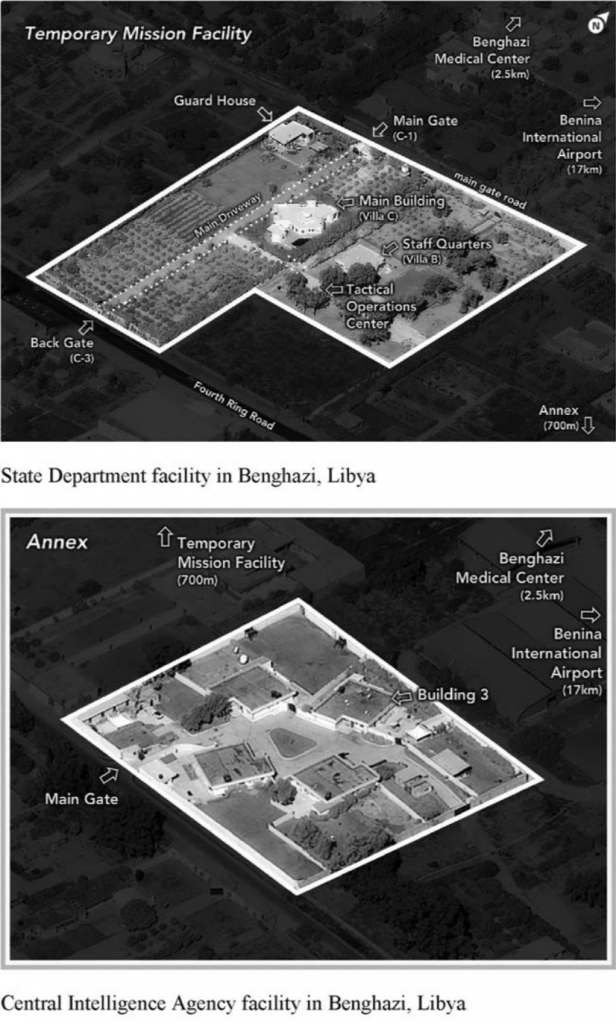
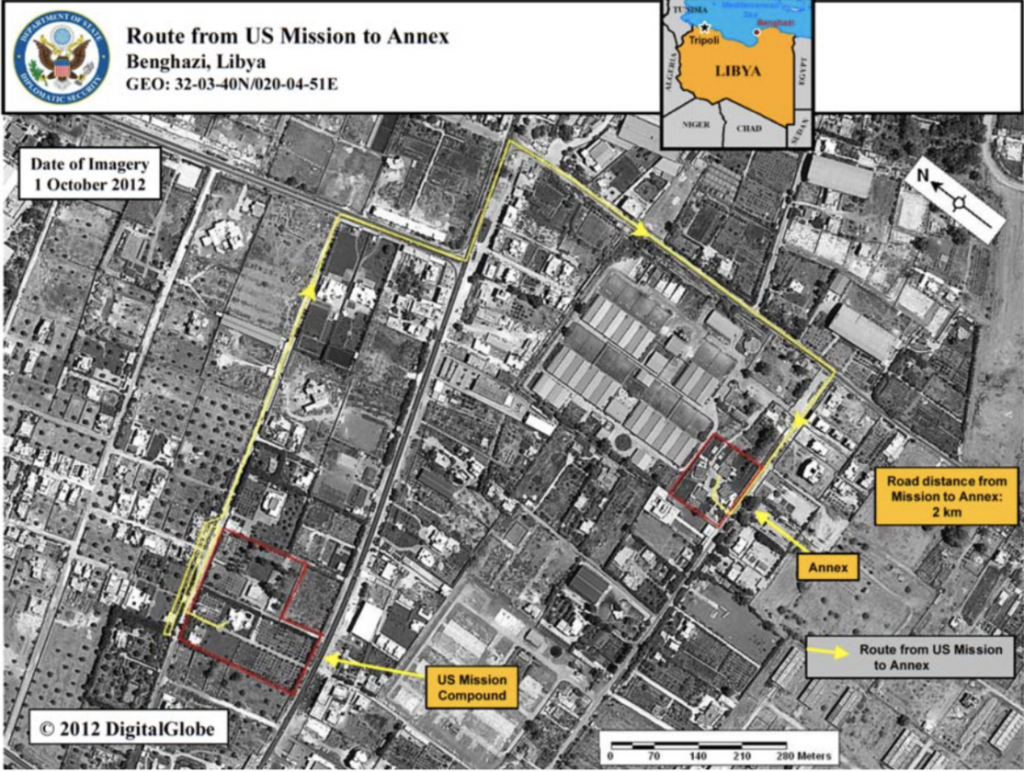
On September 11, 2012, armed militants killed Ambassador J. Christopher Stevens and the State Department’s Sean Smith during the initial raid on the CIA annex. Two hours later during a second assault of mortar, explosive artillery shells, being dropped on the annex’s roof, diplomatic security agents Tyrone Woods and Glen Doherty were killed.
From the first call of, “we’re under attack,” from Stevens to the deputy mission chief Gregory Hicks at the embassy, to an email from the State Department to the White House and Pentagon announcing the attack, it was suspected the islamic militant group Ansar al-Sharia was to blame. Ansar al-Sharia was a Islamist militia group that advocated the implementation of strict Sharia law, relating to Islam and practices to ensure divine favor in the after life, across Libya. Declared as a terrorist organization by the United Nations Security Council and sanctioned for activities with Al-Qaida, the hunt for members associated with the Benghazi attack was broader than the United States. But issues arrived in the detaining and charging of Benghazi attack suspects due to an inability to create a cohesive definition for terrorism. And the differentiation is not only restricted to creating a global definition, but a state definition as well.
In the United States alone has two variations of the definition for terrorism varying on the department and jurisdiction.
Federal Bureau of Intelligence (FBI)
International terrorism: Perpetrated by individuals and/or groups inspired by or associated with designated foreign terrorist organizations or nations (state-sponsored).
Ex. the December 2, 2015 shooting in San Bernardino, CA, that killed 14 people and wounded 22 which involved a married couple who radicalized for some time prior to the attack and were inspired by multiple extremist ideologies and foreign terrorist organizations.
Domestic terrorism: Perpetrated by individuals and/or groups inspired by or associated with primarily U.S.-based movements that espouse extremist ideologies of a political, religious, social, racial, or environmental nature.
Ex. the June 8, 2014 Las Vegas shooting, during which two police officers inside a restaurant were killed in an ambush-style attack, which was committed by a married couple who held anti-government views and who intended to use the shooting to start a revolution.
Central Intelligence Agency (CIA)
The Intelligence Community is guided by the definition of terrorism contained in Title 22 of the US Code, Section 2656f(d):
The term “terrorism” means premeditated, politically motivated violence perpetrated against noncombatant targets by subnational groups or clandestine agents.
The term “international terrorism” means terrorism involving the territory or the citizens of more than one country.
The term “terrorist group” means any group that practices, or has significant subgroups that practice, international terrorism.
The differences between these two are one, the FBI definition pertains more so to terrorism in the United States and differentiates based on their origin or influence. So if their intent was based in a foreign philosophy or American policy. Versus the CIA’s definition which does outline terrorism happening outside of the United States. The second difference is the detail noted in the CIA’s definition notating it must be “premeditated” and “politically motivated” as in a purpose of overthrowing or changing some form of government policy.
When a Benghazi attack suspect is charge in the United States, the legislations will most probably reference CIA policy.
Defining terrorism on an international scale is more difficult though. Take the United Nations for example. While the United Nations does have an Office of Counter-Terrorism, it doesn’t have an updated uniform definition of terrorism.
The late definitions produced by the United Nations was in 1992:
“An anxiety-inspiring method of repeated violent action, employed by (semi-) clandestine individual, group or state actors, for idiosyncratic, criminal or political reasons, whereby – in contrast to assassination – the direct targets of violence are not the main targets.”
On the Next Episode of Overly Complicated, How did media portray the Benghazi attack? How was it perceived by the public?
Appendix
Bibliography
Beauchamp, Zach. “Who were the Benghazi attackers.” Vox, Vox Media, 22 Oct. 2015, https://www.vox.com/2018/11/20/17996154/who-were-the-benghazi-attackers
Burnett , Erin. “Benghazi Attack Timeline – CNNPolitics.” CNN, Cable News Network, 21 Oct. 2015, www.cnn.com/2013/08/06/politics/benghazi-attack-timeline/index.html.
Goldman, Adam., Schmitt, Eric. “Benghazi Attacks Suspect Is Captured in Libya by U.S. Commandos” The New York Times 30 Oct, 2017: n.a. Nytimes. Web. 29 Nov 2018
“Terrorism FAQs.” Central Intelligence Agency, Central Intelligence Agency, 19 Apr. 2013, www.cia.gov/news-information/cia-the-war-on-terrorism/terrorism-faqs.html?tab=list-3.
“Terrorism.” FBI, FBI, 3 May 2016, www.fbi.gov/investigate/terrorism.
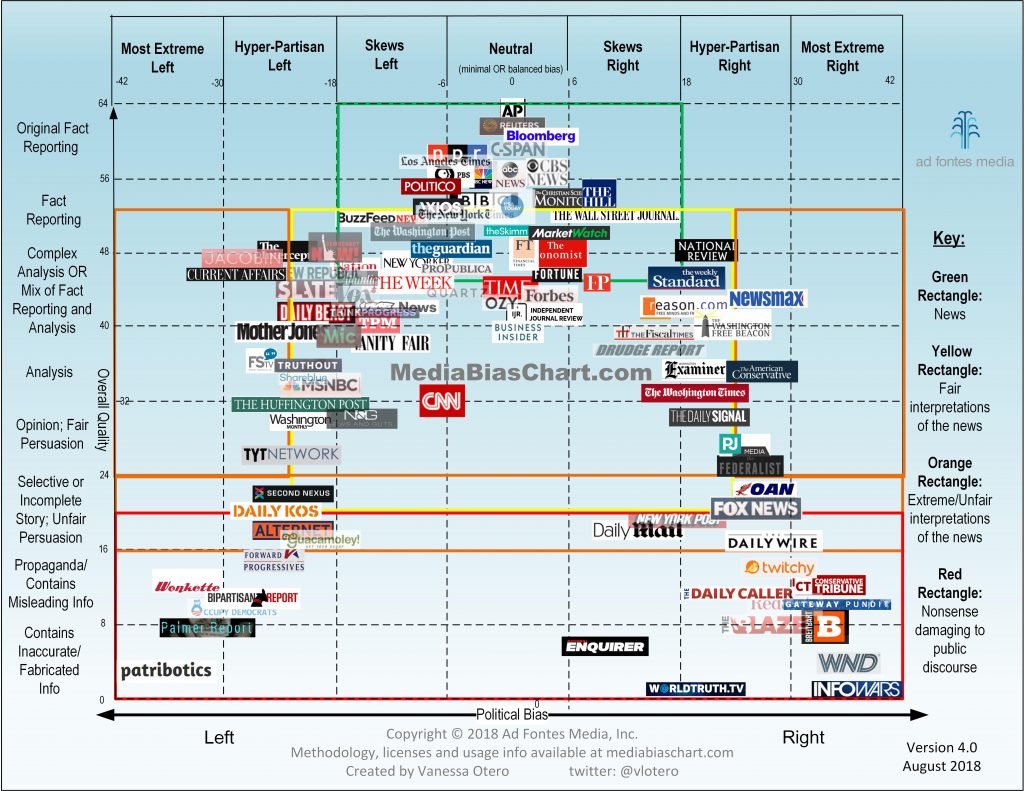
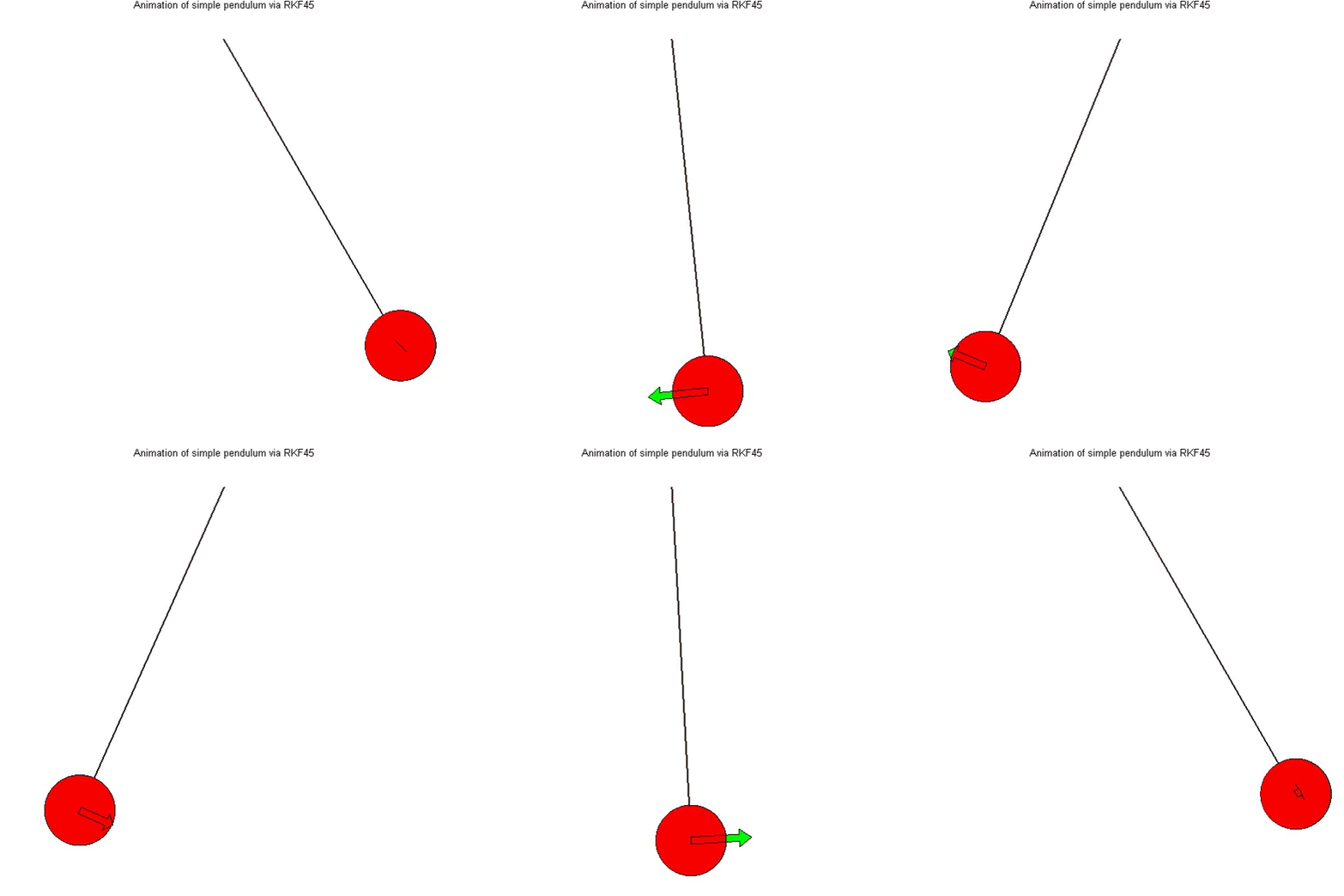
Imagine you are holding one end of a string in the air as the other end hangs towards the ground and tied to it a washer (or any weighed item). If you were to flick your wrist, no matter the force applied, the movement would travel down the string to the washer and it would begin to swing back and forth; left to right. In science, this is referred to as a pendulum, “a body suspended from a fixed point so as to swing freely to and fro under the action of gravity”. But this action can also be observed in the media and its coverage of news. If compared, the fixed point would be the event/topic being covered since, at this point, it is just facts. Facts don’t become compelling until a force is applied; so the flick of your wrist would be the media outlet (i.e. Fox, CNN, Vox, The Washington Post, etc.). And the washer being affected by the force would be you, the audience. This is important to understand because regardless of where you receive your information, it will contain a bias.
Bias is like that one love song popularized by Louis Armstrong La Vie En Rose which literally translates to “life in pink”, as in rose colored glasses. This means your view on life is tainted by this rose hue of love so everything appears better than it actually is. And while your choice of media outlet does not make the situation better or change what actually happened, its bias does alter your opinion.
For media, this is discussed as a spectrum swinging from far left, leftish, the middle, rightish, and far right. The left is characterized as being more liberal and often (not always) synonymous with the democratic party while the right is characterized as being more conservative and often (not always) synonymous with the republican party.
This is important to know pertaining to the Benghazi attack because of the onslaught of blame being tossed around after the attack occurred and the investigations started. Because as you go beneath the surface of four Americans being killed by islamic militant at a CIA annex, you begin to question certain realities and whether or not they are true. Such as how militants getting into a CIA guarded building in the first. Were the guards simply overpowered or were there not enough guards to begin with? If not, who was responsible for reporting insufficient security and dispersing more guards if the report proved true? Worries such as these and more were proposed by the republican party on to the democratic party but maybe not without an ill conceived motive pushing it. For context, during the time of the Benghazi attack, President Barack Obama had just been elected into office as the President of the United States and the democrats held the majority in the senate. This strongly affected the policies and laws that were passed during President Obama’s second term, also making it difficult for republicans to get anything through. Thinking the consequences of the Benghazi attack forward, the republican party may have saw it as an opportunity to shame the democratic party and cast doubt in the public’s perception of the democrats competency.
On the next episode of Overly Complicated, Why did the Benghazi attack turn into a feud between the republican and democratic parties?
Appendix
Bibliography
CASSATA, DONNA. “Democrats Retain Senate Control On Election Night.” The Huffington Post, TheHuffingtonPost.com, 7 Nov. 2012, www.huffingtonpost.com/2012/11/07/senate-results-2012_n_2039118.html.
“Pendulum.” Merriam-Webster, Merriam-Webster, www.merriam-webster.com/dictionary/pendulum.

In the United States, democracy is practiced as a representative democracy meaning the citizens, instead of directly voting for policies and leadership themselves, vote for representatives to express their concerns and needs to higher authorities. The current American democracy is a two party system alternating control between the Republican party and the Democratic party. While not completely depicting the entire state, majority of US citizen fall on one of the two sides identifying either as a democrat or a republican. This system leaves little for remaining citizens wanting to vote for the libertarian party (or other canaidits); often depicted as throw away votes.
Because of there being two major parties, responsibilities of the United States are often split between the two. This was on full display during the Benghazi attack investigation where the republican party searched for who was to blame for Ambassador Christopher Stevens death due to a lack of security.
During the beginning of the House Select Committee hearing on Benghazi, republican federal prosecutor Trey Gowdy opened,
“Chris Stevens, Sean Smith, Glen Doherty and Tyrone Woods served this country with courage and with honor. And they were killed under circumstances that most of us could never imagine. Terrorists poured through the front gate of an American facility, attacking people and property with machine guns, mortars, and fire. It is important that we remember how these four men died. It is equally important that we remember how these four men lived and why. …. Why were there so many requests for more security personnel and equipment, and why were those requests denied in Washington? Why did the State Department compound and facility not even come close to meeting proper security specifications? What policies were we pursuing in Libya that required a physical presence in spite of the escalating violence?”
And the points he brings up are well found. Four men of American origin were killed and died in a place that wasn’t their home. And the least the United States could do in honor of their deaths would be to find those responsible. But a mission for a good cause was exploited by the republican party and house hearing turned into a nit picking and an elven hour long session of interrogation without analyst.
Appendix
Bibliography
Staff, TIME. “Hillary Clinton Benghazi Hearing: Read Her Opening Statement.” Time, Time, 22 Oct. 2015, time.com/4083494/hillary-clinton-benghazi-hearing-opening-statement/.
In episode 4, How?, of Overly Complicated I referenced news outlets and their media bias to a pendulum. How a bit of force, or forced perspective, applied by the media can alter the audience’s opinion of an objective topic. And as I further explored what the Benghazi Attack was, as in what happen before September 11, 20112, how it may have impacted the attack, and the fall out of its consequences, I can rationalized that the Benghazi Attack itself is a pendulum.
The facts:
Before September 11, 2012 the country of Libya and countries in its surrounding area were in turmoil due to the Arab Spring – a revolution of citizens against the dictators of their respective countries for a variable of reasons such as freedom, jobs, and lower food prices.
Ambassador Christopher Stevens arrived in Libya in April 2011 during the start of the Libyan Revolution as the United States representative to the Transitional National Council for six month before returning to the United States. Upon his return to the United States, Stevens was nominated and awarded the position of becoming the Ambassador of Libya. Ambassador Christopher Stevens returns once more to assume his responsibilities as Ambassador of Libya, as well as work to better US relations in Libya and create a permanent Benghazi consulate.
More security was requested for Ambassador Christopher Stevens as his security detail was inadequate for their current environment. The request was denied.
On September 11, 2012 United States Ambassador Christopher Stevens and three other Americans –information officer Sean Smith and Navy SEALs Glen Doherty and Tyrone Woods – were killed.
The Controversy:
Appendix
Bibliography
Burnett , Erin. “Benghazi Attack Timeline – CNNPolitics.” CNN, Cable News Network, 21 Oct. 2015, www.cnn.com/2013/08/06/politics/benghazi-attack-timeline/index.html.
Gowdy, Trey. Final Report of the Select Committee on the Events Surrounding the 2012 Terrorist Attack in Benghazi House of Representatives together with Additional and Minority Views. Washington, D.C: 2016. Print.
Reflection: Serial, Serial Blog, Benghazi Project
In fall of 2018 I became a first year at Agnes Scott College and attended my first Intro to World Politics course. In this course I learned about government systems outside of the United States, such as the European Union and the United Nations for example and deconstructed their policies. Doing so, while also attempting to create solutions out of found issues, I became more aware of the world around me. I knew of globalization before Pol 103, but I had never thought of it as in depth as the T-Shirt Travels film had in its exploration of the secondhand clothing industry. Whenever I donated clothes, I only ever thought of it as something positive and never considering where surplus or unsold merchandise was being sent.
Through the Serial podcast I learned about a military case I most likely would have never heard of before. Serial was also my first introduction to podcast as I have never listened to one before, and now I know why. Whenever I attempted to just listen to Serial out loud or through headphone, I was never able to retain any information. In order to write my Serial Podcast blogs, I would have to read through the transcript provided on the site and take notes in order to have anything to write about.
Through the Benghazi Project and the multiple bibliographies I created, I’ve become confident in my ability to write citations (but still struggle with writing citations for government sources). I also learned how to identify bias in media source as well as the different types of sources such as academic journals, news articles, and peer articles. I also learned how to officially use Galileo efficiently.
As for my global engagement, I would say I am more active due to me knowing more about current foreign policy, but I still think my knowledge is only puddle deep in comparison to my peers.
In the end, while I might not assume International Relations as my major, intro to world politics was a useful course.